Outsmarting shady contractors with AI and surviving when your brain leaves
From outsmarting HVAC scams with AI to managing family chaos with custom apps, discover how tech can augment your biggest life decisions. Let’s dive in!
How I Used AI to Outsmart Shady Contractors (And Save Thousands)
There’s nothing quite like that specific, sinking feeling of waking up in the morning to a house that feels… off. The air is heavy, the vents are silent, and you realize a critical piece of home infrastructure has gone offline.
Here in Hamilton, we’ve been lingering in that classic Canadian limbo—seasonably cold, grey skies, and very few days cracking 20°C. Then, the atmosphere shifted. It wasn't a full heatwave, but it was that first genuine, humid afternoon that serves as a loud reminder: summer is coming.
Naturally, that was the exact moment our AC unit went on strike.
Interestingly, the unit turned out to be older than the house itself—a special kind of "builder-grade magic" when you live in a new build. The technician who diagnosed the leak gave me that look you only get when a mechanic is about to tell you your transmission is sitting on the highway three miles back. He was right.
The AC, however, was just the setting. The real story is what unfolded at my kitchen table over the course of two weeks, and it completely rewrote my playbook on how to make major life decisions.
The Setup
I'd already been using Claude for work projects—coding, database architecture, research synthesis. The usual technical stuff. I hadn't really thought about using it for a major personal purchase. But the day after the diagnosis, I had three HVAC sales appointments stacked back-to-back, and I realized I had no idea how to evaluate any of them. Brands I didn't know, refrigerants I'd never heard of, and warranties written in a language that wasn't quite English.
So I opened a chat window and started feeding Claude everything.
When the first quote came in, I dropped the PDF into the chat. Within minutes, Claude pulled it apart line by line: flagged that the unit was oversized, decoded the hidden warranty terms, surfaced the company's Better Business Bureau complaints, and caught that the salesperson had completely misrepresented the government rebate program.
That baseline audit took ten minutes. It would have taken me three hours of furious Googling to get to the same place, and I probably wouldn't have caught half of it. That was the moment I realized this was going to be a completely different kind of decision-making process.
How It Actually Worked
Over the next two weeks, I had eight HVAC contractors come through the house. Each one arrived armed with a clipboard, a quote, and a blindingly strong opinion about what I needed to buy right this second. It was asymmetric warfare: their full-time job was selling, and my part-time job was trying not to get ripped off.
The workflow I settled into looked like this:
1. Before the meeting: I'd ask Claude to brief me on the specific manufacturer, what red flags to listen for, and what questions to ask. By the time the contractor arrived, I had a mental checklist ready.
2. During the meeting: I focused entirely on human behavior. Did they actually bother to look at the broken unit, or just stand in my driveway? Did they ask about our home's layout, or just try to calculate the maximum capacity of my credit card?
3. After the meeting: I'd return to the kitchen table and replay the pitch with Claude. I'd input the numbers, the small print, and my qualitative impressions. Claude would run the background check—pulling public records, verifying factory model numbers, and surfacing the things the contractor conveniently left out.
Neither of us would have caught everything alone. I brought the read of the room; the AI brought the relentless data synthesis.
Four Moments That Mattered
There were four specific milestones where this partnership genuinely stopped me from making a massive mistake:
1. The suspiciously low price
One company sent a charming rep with a great pitch and a suspiciously low price. I had the pen in my hand. Then Claude went digging into the corporate history and uncovered its parent operation—which was facing 142 charges under Ontario's Consumer Protection Act, had a history of registering hidden liens on customers' property titles, and had quietly rebranded three times in ten years. Every time the lawsuits piled up, they just changed the font on their logo and started over. I would have signed that contract.
2. The Model Number That Wasn't
Another contractor quoted me a unit at an aggressive price. I dropped the model number into the chat. Claude flagged that the SKU didn't match any standard catalog code from that manufacturer. The quote unraveled instantly. It turned out the unit was a discontinued clearance model being sold completely outside the consumer-protection programs the contractor had implied were attached to it. Without that catch, I would have thought I was buying a premium new system and actually bought the mechanical equivalent of the "final sale" rack.
3. The Tier Reveal and the Rebate Trap
Late in the process, I had a quote from a local contractor I really liked. He was an older guy, decades in the trade, who earned my trust by telling me directly that the massive federal heat pump rebates everyone else was waving around didn't actually work for my standard gas furnace setup.
He was leading the pack on honesty alone. Out of due diligence, I asked Claude to do a final side-by-side against the warehouse-club option I'd been considering. What we found broke the tie: the warehouse-club deal was a full tier higher in equipment quality, featured a newer-generation refrigerant, offered a longer labor warranty, and after the cashback rewards, it was several hundred dollars cheaper. The honest contractor set the baseline for trust, but the data-driven choice ultimately came down to the absolute value of the warehouse-club tier.
4. The Contract Catch
The winning contractor sent over the final paperwork. By this point, I'd been at this for two weeks, I was exhausted, and I almost signed it just to stop talking about airflow. Claude pulled the text apart line by line and surfaced that the labor warranty described in our text messages had vanished in the final legal document—shrinking dramatically unless I paid for an unmentioned annual maintenance plan. That catch was worth real money. I went back, negotiated a fair middle ground, and got it amended in writing before the ink dried.
The Moral of the Story
A few things crystallized over these two weeks that apply to almost any major lifecycle decision:
1. Don't outsource the thinking; outsource the homework. I never asked the AI "which AC should I buy?" I asked it to research, cross-check, and stress-test my own developing instincts.
2. Speed is the enemy of a good deal. Taking that extra day to pause, run the numbers, and verify always surfaced something critical.
3. If a company treats corporate rebrandings like a series of getaway cars, walk away. Pay attention to corporate history. The internet has a long memory; use it.
4. Read the final contract against the text messages. Verbal and email promises are fine—until they're missing from the legally binding document.
The future of this technology isn't automation that replaces us; it’s augmentation that amplifies us. The decisions I made were entirely mine. But I made them with more information, zero fatigue, and a much sharper edge than I could have managed alone.
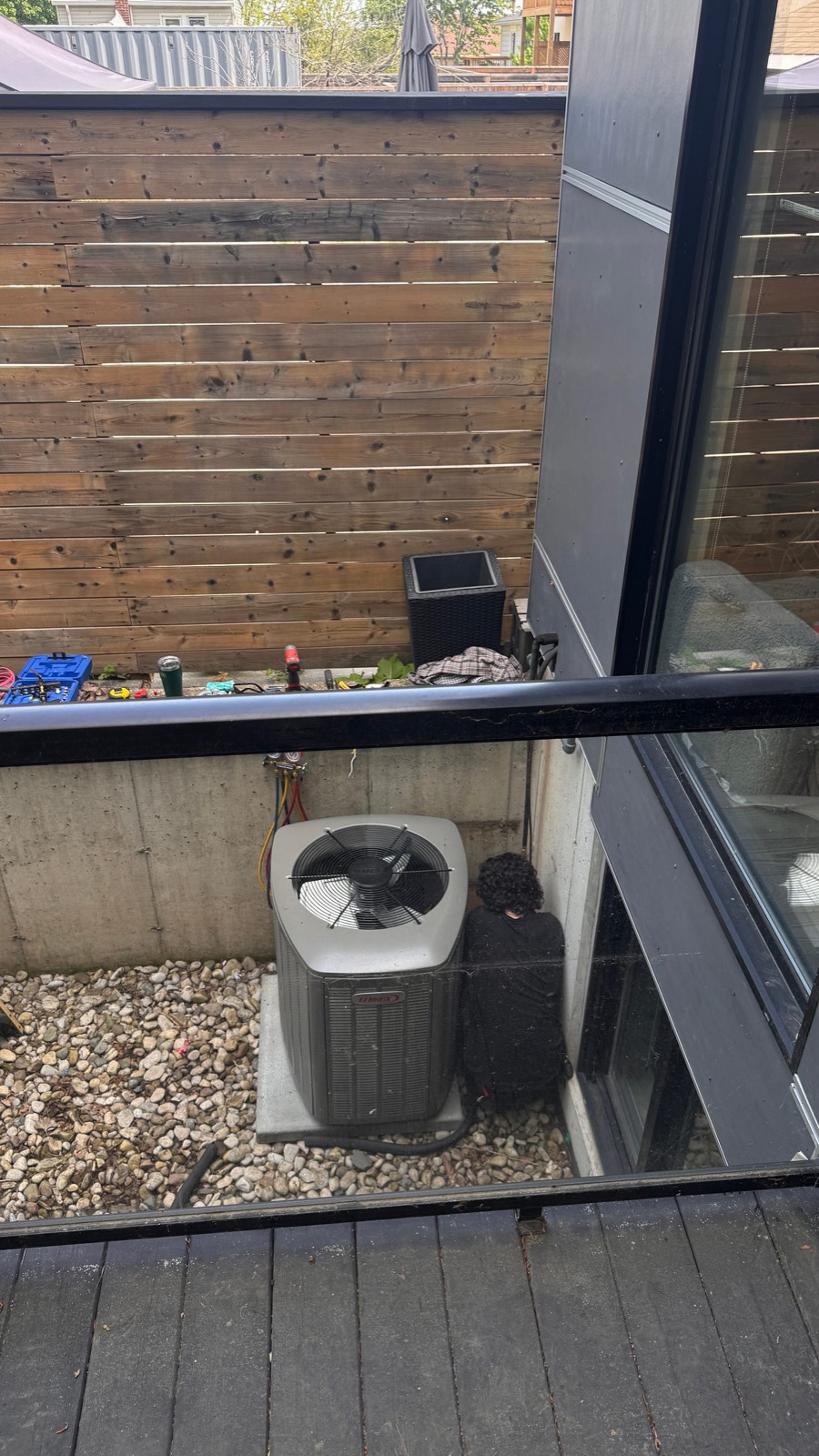
The new AC is humming away in the side yard. The installation team smashed the deployment out in a single day, correcting a long-standing builder bottleneck by using our home's original architectural blueprint sheets to prove the original system had been undersized from day one.
For the first time in four summers, the top floor of the house is actually cool. And I have a new tool in my toolkit for the next big decision. Whatever it is.
Next week: We’re shifting gears from home infrastructure back to the home front. Katerina was away on a business trip this week, leaving me on 100% solo dada duty with two dogs and a toddler who has fully unlocked the power of chaos. We'll talk about high-stakes morning routines, tiny helpers, and surviving the week through sheer determination.
Until next time, keep building!
The Week My Brain Left the Building - A dispatch from the other side of too much.
It started in Bangkok.
January. Night meetings, a laptop open while the city hummed outside, and a conference that existed mostly as a shared document and collective anxiety. By May, it had a program, a staffing plan, 46 sessions across five tracks, and 240 people who expected things to run smoothly. What it did not have was a plan for who would brush Alyce’s teeth. That part was on me.
Here is something nobody tells you about leaving your family for a work trip: you don’t just pack a bag. You pack a bag, and then you spend the week before doing a second, invisible job. Fridge stocked. Dog food inventoried. Nanny briefed. And then — the main event — a conversation with Damian, two days before my flight, in which he said with complete sincerity: “I know nothing about this child.”
Alyce is two years and five months old. She lives in our house. She has opinions about her snacks.
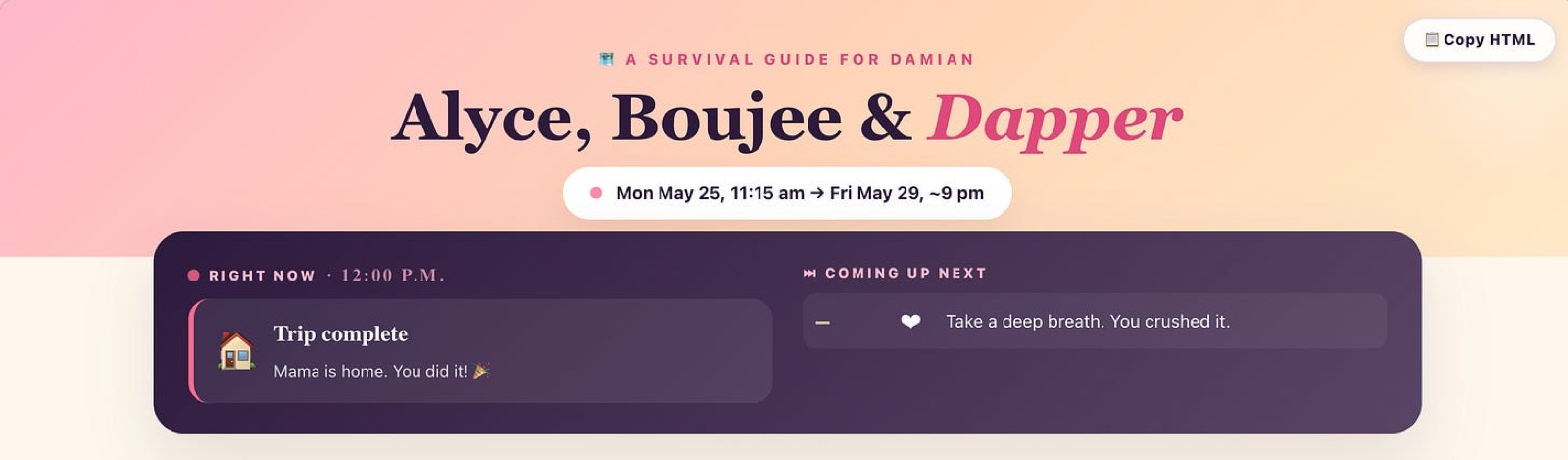
He suggested I fill in a page…I coded him an app.
The conference was a lot. Our team had been handed this event when we were three people. By May, we were two. For three days I was on — that particular vigilance of conference organizing, the background hum that doesn’t quiet even when you’re technically just standing in a hallway. And then, before that hum had a chance to fade: the staff retreat. My social meter filed a formal complaint sometime Friday morning and has not been heard from since.
The flight home was delayed, the landing was eventful in a way I will not elaborate on, and I arrived late with bags still on my shoulders. I went to find them. Damian, Alyce, Boujee and Dapper — all at the park, in the evening light. Alyce did not care about the conference. The dogs forgot I had ever been gone. We walked home, my luggage strolling in Alyce’s Veer wagon along the sidewalk. That was the decompression that actually worked.
The app held up perfectly, by the way. He followed the schedule without texting me once. Whether he brushed her teeth I cannot confirm. I have chosen not to investigate.
It is the weekend after and my brain has left the building. Not burnout — more like the silence after a long piece of music. Bangkok feels like a long time ago. The park feels like yesterday. Next week I will have thoughts again. This week, I am simply glad to be home.