Turning Playful Meme Tagging into Bold Travel Plans and Sincere Commitments
Uncover the cultural nuances of casual commitments in North America versus Eastern Europe in this engaging newsletter excerpt. #Communication #Accountability
From Empty Promises to Real Action: The Cost of "We Should Go to Brussels
We play a lot of "meme tag" in our household. It’s how Katerina and I show love throughout a busy week—sending quick, funny, or insightful clips back and forth to say, “Hey, I’m thinking about you.”
But a few days ago, Kat sent me a video that made me laugh out loud, immediately followed by a cold sweat.
The video was by a woman from Moldova who has lived in Canada for over twelve years. She was venting about the one North American cultural norm she simply cannot accept: the casual phrase, "We should do something together!" followed by absolutely zero action.
She illustrated the danger of this cultural collision with a story about visiting her family back home in Moldova with her North American husband. They were out drinking wine with friends when her husband casually said, "We should go to Italy in a couple of months."
To him, it was just standard social white noise. A polite, warm sentiment meaning, "Hey, Italy sounds cool, wouldn't that be neat?"
But his wife knew her people. She instantly thought, “Oh no. This is going to be a massive problem.”
Sure enough, two months later, she got a text from her Moldovan friends: "Hey! We all bought our tickets. When are you arriving?"
Boltovnya vs. Answering for Your Words
The video broke down exactly why this happens, and it comes down to two distinct linguistic frameworks.
In Eastern Europe, there is a specific word for making casual, empty suggestions you don't actually intend to keep: boltovnya (болтовня́). It means idle chatter, babble, or hot air. Engaging in it is a guaranteed way to lose someone's respect instantly.
Instead, they operate under a completely different rule: za bazar otvechat (за базар отвечать). It roughly translates to "answering for your market talk." It means you are 100% accountable for the words that come out of your mouth. Every. Single. One. If you say "let's," it means the wheels are already turning. The project has been green lit.
When I watched that, I had to look in the mirror. Because guilty as charged. In North America, "we should do something" is usually just a verbal hug.
But Kat is Eastern European. And finding this out about her suddenly connected a lifetime of dots for me. When Kat talks about something she really means it. She doesn't do air.
When "Wouldn't That Be Nice" Meets Reality
I realized we can be casually talking about a concept, and before I even register that a decision has been made, Kat has already started and finished it.
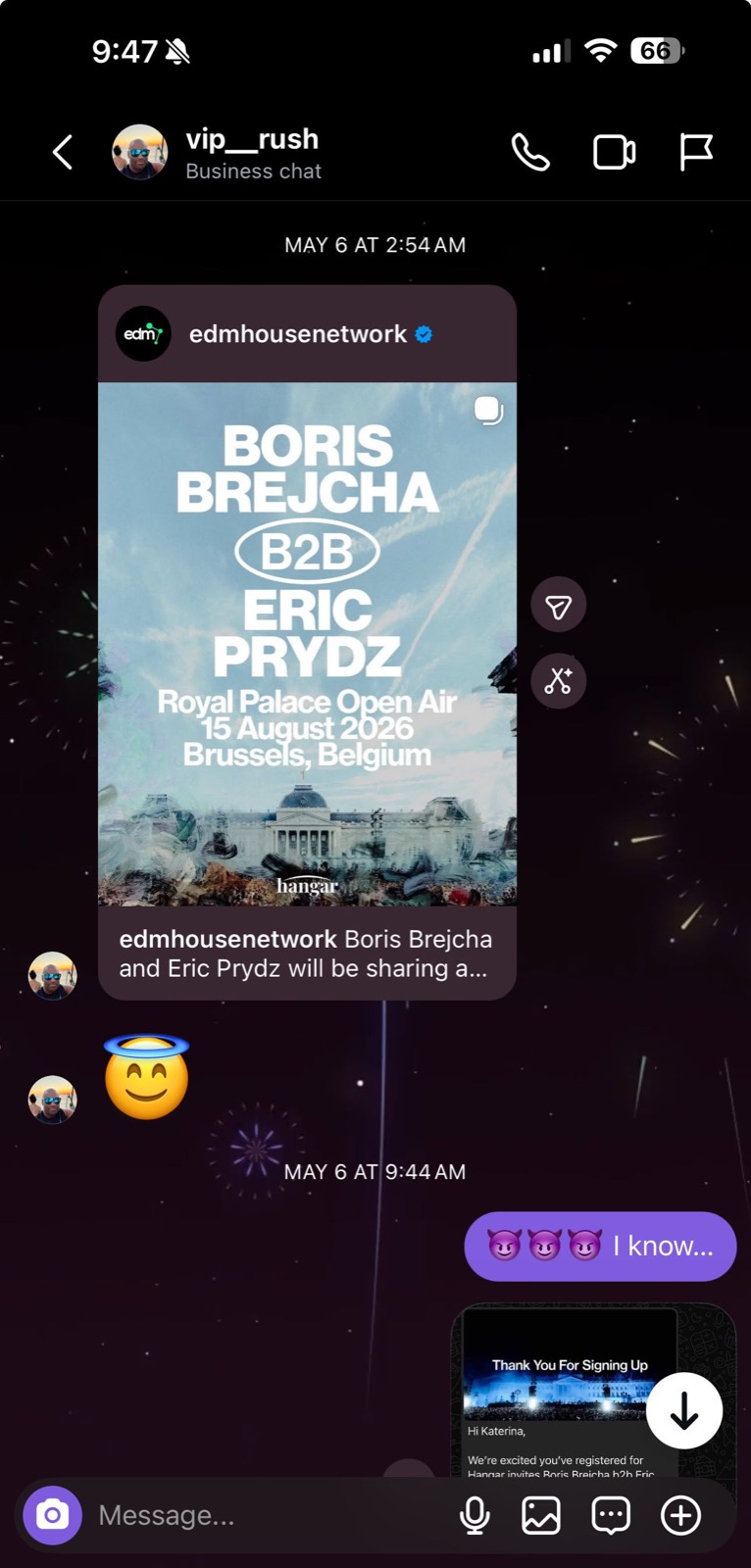
Case in point: Not long ago, I saw a post online showing that one of my absolute favorite electronic music producers, Eric Prydz, was scheduled to play a massive set in Brussels. I’m a lifelong fan of the music, so I immediately shared the post with Kat. In my mind, it was purely a moment of: "Wow, look at that. Wouldn't that be nice?"
I hit send, closed the app, and thought absolutely nothing of it.
A week later, Kat sends me a screenshot of "your confirmation code is" then comes down, looks at me completely unprompted and says, "Okay, I bought the tickets."
My brain completely glitched. "Tickets? Tickets to what?''
"Eric Prydz."
My jaw hit the floor. Kat didn't see a casual share. She saw a project brief. Because of her background, she assumed that if I sent it, it meant I wanted to go, and therefore it was time to move to the execution phase.
We haven't actually booked the flights yet—but time is rapidly running out to back out. And because I have a non-negotiable operational norm of my own (if the tickets are bought, you must go), it looks like I’m heading to Belgium.
But as the dust settled from the shock, I realized her hyper-execution engine had accidentally tripped over the most sacred memory of my life.
The Song Alyce Was Born To
You see, Eric Prydz holds a special, permanent place in my heart. His track "Opus" is the song my daughter, Alyce, was born to.
I remember the day vividly. They took Kat into the operating theater, handed me my scrubs, and left me sitting there. I was terrified, overwhelmed, watching doctors and nurses rush past in a blur.
Suddenly, a nurse ran up to me and asked, "What's the song?"
I blanked. "What, what song?!"
She said, "Your wife told me you know the song for the baby's birth."
I completely froze. I searched every single corner of my brain and came up totally empty. Panic rising, I asked for a minute. The nurse nodded and stepped out.
I closed my eyes, let my brain dance through the memories, and forced life to slow to a crawl. And then, out of the darkness, it hit me: Opus.
I rushed to the door and gave the nurse the track. When the music started playing in the operating room, the atmosphere completely shifted. The doctors looked around, laughed and started moving as if the C-section suddendly became a dance, "Wow, this is a dance party! We like this!"
If you know electronic music, you know Opus is famous for its legendary, soaring, multi-minute build-up. Alyce arrived right around the first or second drop. But just as the third and final drop hit its absolute peak mark, little miss Alyce let out her very first cry.
It is a cinematic memory etched into my soul. To this day, every single time I hear that song, I am entirely overcome with emotion.
Kat didn't just buy concert tickets. By operating in her default, fast-execution framework, she handed us a ticket to go celebrate the anthem of our family's beginning.
Elevating the "Say/Do" Ratio
What started as a funny quirk of geography actually points to a much bigger truth about leadership, integrity, and personal responsibility.
If we claim to value radical responsibility in our lives, that accountability can't stop when our language gets casual. Your intent might be warmth, but if your impact is unreliability, you're still failing the test.
Consistently letting your words drop kills your "Say/Do" ratio. It dilutes your currency and makes your commitments mean less over time.
Maybe we all need to borrow a page from the Eastern European playbook. If we don't have the time, the budget, or the genuine intent to book the flight, we shouldn't dangle the trip. Let's kill the empty boltovnya and start saying what we actually mean.
And if you do decide to send a link or say "let's do something"—you better be ready to stand by your words. Even if it means flying across the world to dance to the song that brought your daughter into it.
This Week's Challenge: Audit Your Words
Over the next seven days, I want you to run a brutal audit on your own Say/Do ratio. Pay close attention to the casual commitments you throw out purely out of habit or social conditioning.
The next time you catch yourself saying, "We should get together soon," or "Let's hop on a call sometime," force yourself to do one of two things:
1. Move to the execution phase immediately: Open your calendar app right there on the spot, pick a date, and lock it in.
2. Change your language: Kill the empty promise and say what you actually mean: "It was great crossing paths with you, I'm glad you're doing well."
Let’s stop generating social white noise and start making our words carry real weight again.
What is one casual commitment you’ve let slide lately that you either need to book or officially drop? Hit reply to this email and let me know— We read every single response.